It was supposed to be the quietest two minutes of a Monday night meeting. It turned into 10 minutes of competing prayers, chants of “USA!”, police escorts, 214 emails, and a national argument about who gets to pray in America — and who gets to stop someone else from praying.
The Night A Routine Meeting Became A National Flashpoint
Bartow is not a big, noisy city. It is the county seat of Polk County, about 40 miles east of Tampa and 60 miles southwest of Orlando, the kind of place where a City Commission meeting usually means potholes, budgets, zoning, and maybe a long discussion about a stop sign.
On Monday, November 16, 2026, the agenda listed something different for the opening invocation: Imam Sajid R. Bhuiya of Masjid Al Nur Mosque in Bartow.
That one line changed everything.
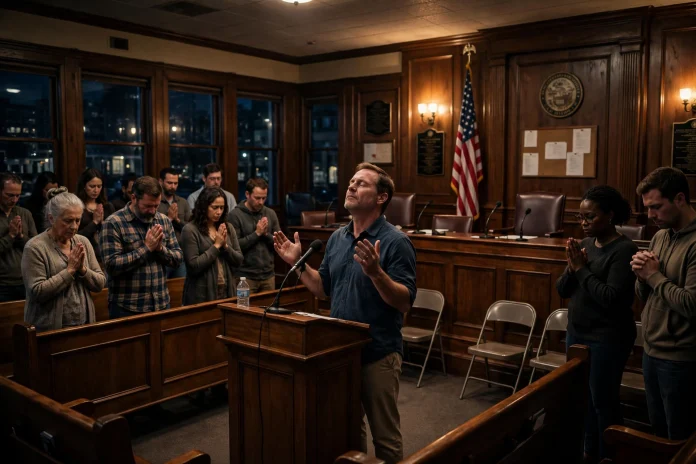
By the time the meeting started, the back of the chamber was packed. When Bhuiya walked to the lectern, dozens of people in the audience did not sit quietly. They stood and began reciting the Lord’s Prayer — in unison, loud enough to drown him out.
Then came the shouts. Then came the chants: “USA! USA! USA!” and “Christ is King!”
One person told Bhuiya to “go back where you came from.” Another shouted, “We don’t pray to that god. This is the USA.”
Mayor Tanya Tucker tried to restore order. She asked the crowd to let Bhuiya give the invocation “and then we will have prayer.” Someone shouted back: “This is a Christian nation, Ms. Mayor!”
A police officer told the crowd to quiet down. Someone asked him, “Are you going to stand with us or bow down to him?”
It took nearly 10 minutes. Police eventually escorted about 20 people out of the chamber. No one was arrested.
And then, in a room that had just been shouting over him, Bhuiya finally prayed.
What The Imam Actually Said
This is the part that got lost in most of the viral clips.
Bhuiya did not preach a sermon. He did not attack Christianity. He did not talk politics.
Here is what he said, according to the city’s official livestream and multiple reports of the meeting:
“Almighty God, we begin by acknowledging you as the creator of the heavens and the Earth, and we ask for your guidance and blessings upon this gathering.”
“This is a reminder that our differences in background, culture and faith should not prevent us from treating one another with dignity, respect and kindness.”
He quoted a passage from the Quran, called the opportunity an honor, and prayed for wisdom, fairness, safety, and service to the community.
That is it. That was the prayer people spent 10 minutes trying to stop.
Wait — How Did An Imam End Up On The Agenda In The First Place?
This is where the story gets weirder, and more human, than the headlines suggest.
It did not start with the mosque. It started with a Hindu temple.
City Attorney Sean Parker explained it during the meeting itself: a man from a local Hindu temple had contacted the clerk’s office and asked to be included in a future invocation. The clerk offered a couple of dates. The dates did not work.
Parker said it was then his idea — not the commission’s — to reach out to Bhuiya and offer the open slot.
Bhuiya accepted. He showed up. He waited patiently while the room shouted.
Parker later put it bluntly: “This is a government meeting, not a religious forum.”
Vice Mayor Laura Simpson added a twist that matters: she said the city “did not invite this invocation” in the usual sense — the date was simply open when the mosque asked for one. But her conclusion was the same as Parker’s: if you shut one faith out, you risk shutting them all out, including Christians who want to pray in Jesus’ name.
In other words, the invitation was not a conspiracy, a takeover, or a political statement. It was a scheduling domino: Hindu temple asks → dates don’t work → city attorney suggests mosque → mosque says yes → agenda goes up on a Friday.
That Friday posting matters, because organizers later complained they had only one business day plus a weekend to react. That short window helped turn a local scheduling decision into a social-media mobilization.
Why So Many People Showed Up
News of Bhuiya’s scheduled appearance spread on social media over the weekend before the meeting.
Robert Goodman, southeast regional director of the conservative activist group Citizens Defending Freedom, was among those who shared it. He later said about 100 people from different groups ended up attending.
Goodman framed the turnout as a defense of Christian voices, not a ban on belief. In a statement to Fox News Digital, he said: “Citizens Defending Freedom believes Christian voices deserve to be heard on matters affecting our communities, families, and freedoms, which is why we joined many other concerned citizens and organizations Monday night.” That original Fox News Digital report is the first detailed account of the protest and Goodman’s role in it.
Read the Fox News Digital report here.
Goodman also criticized some of the Quran’s teachings on women and submission, and argued that the prayer did not belong at the opening of a city meeting in a historically Christian community.
But he drew a clear line on the insults. He said the “go back to your own country” remarks and other disrespectful comments came from two or three individuals and did not represent him or his organization.
“The disrespectful remarks made by two or three individuals Monday night do not represent me or Citizens Defending Freedom, because as Christians, we are called to speak truth with conviction and respect, not insults.”
— Robert Goodman, Citizens Defending Freedom
That distinction is important. The room was not one mind. Some people came to pray loudly in protest. Some came to shout. Some came to watch. Some came because they felt their town was changing without being asked. Lumping them all together misses why this moment hit a nerve.
What The City Said Afterward
Two days later, on November 18, the City of Bartow issued a full written statement. It did not apologize for the invitation. It defended it.
“For years, it has been tradition to open Bartow City Commission meetings with a prayer offered by either a faith-based leader or one of the City’s elected officials. While historically the opening invocation/prayer is one based on Christian traditions, the opportunity is open to all faiths. This is consistent with the United States Constitution.”
— City of Bartow, November 18, 2026
The city said residents “joined by individuals from other cities, attempted to prevent the imam from speaking and the Mayor from proceeding to conduct the business at hand.” It said those who refused to stay silent were escorted peacefully from the chamber by Bartow Police officers. No arrests were made.
Laurie Hayes, the city’s director of communications, told reporters the same thing in plainer language: the prayer slot has historically been Christian, but it is open to all faiths, and that openness is what the Constitution requires.
City Manager Mike Herr joined other officials in urging residents and religious leaders of all faiths to help keep Bartow welcoming.
The Commissioner Who Stole The Meeting — By Being Calm
If there was a hero of the night, it was not the loudest person in the room. It was Commissioner Trish Pfeiffer.
During public comment, Pfeiffer revealed that by 5:16 p.m. that day, commissioners had already received 214 emails about the invocation. More than an hour of public comment focused on the prayer.
Then she said the line that has been quoted everywhere since:
“We govern a city of people, not a congregation of faith. As elected officials, we have a responsibility to uphold those principles, even when doing so may be unpopular. We do not have to share someone’s faith to respect their right to practice it.”
— Commissioner Trish Pfeiffer
She said allowing someone of any faith to offer an invocation does not diminish anyone’s Christianity.
And then she did something no one expected: speaking as a Christian, not as a commissioner, she invited those present to join her in the Lord’s Prayer herself.
That moment captured the whole tension of the night. The same prayer that was used to drown someone out was also used, minutes later, as a peaceful, voluntary prayer led by an elected official who had just defended someone else’s right to pray.
Same words. Completely different spirit.
So Is This Legal? The Supreme Court Already Answered This — Sort Of
Here is where Bartow stops being just a Florida story and becomes an American story.
The United States Supreme Court has ruled on legislative prayer before, and its answer is more nuanced than most viral posts admit.
In
Town of Greece v. Galloway (2014), the Court ruled 5-4 that a town does
not violate the Establishment Clause by opening its meetings with prayer, even if that prayer is explicitly Christian, Jewish, Muslim, or otherwise sectarian.
The key is not whether the prayer mentions Jesus, Allah, or Jehovah. The key is whether the town discriminates in who gets to pray, coerces people to participate, or uses prayer to denigrate or proselytize.
Justice Anthony Kennedy, writing for the majority, said forcing prayers to be nonsectarian would force legislatures and courts to act as “supervisors and censors of religious speech.” The Court also said legislative prayer is primarily for the lawmakers, to put them in a solemn and deliberative frame of mind — not to convert the audience.
That is why Bartow’s defense matters legally: the city says the slot is open to all faiths. Under
Town of Greece, a Christian-majority town can have mostly Christian prayers
if it does not shut out minority faiths. Once it opens the door to one, it cannot slam it on another because the audience does not like that faith.
Pew Research Center’s breakdown of that 5-4 ruling explains the balance the Court tried to strike — prayer is allowed, but denigration and coercion are not.
Read Pew’s analysis of Town of Greece v. Galloway here.
The Third Side No One Expected: “End All Prayers”
Just when you think this is a Christian vs. Muslim story, a third group walks in and says: you are both wrong.
The Freedom From Religion Foundation (FFRF) sent a letter to Mayor Tucker and the City Commission condemning the disruption — but also urging the city to
end all official prayers at meetings.
Their argument is simple: government meetings should be devoted to the public’s business, not religious exercises that invite division. By putting prayer into official proceedings, the city makes religion a focal point of civic participation, even when it tries to be fair.
“Government meetings should be devoted to the public’s business, not religious exercises that invite division and conflict. By incorporating prayer into its official proceedings, the Commission has unnecessarily made religion a focal point of civic participation.”
— FFRF Legal Counsel Chris Line
FFRF also praised the commission for restoring order, and noted that
Town of Greece requires non-discrimination against minority religions if a city keeps prayer at all.
You can read FFRF’s full letter and position in its own statement on the Bartow incident.
Read FFRF’s statement here.
So now Bartow has three competing visions on the table:
- Keep prayer, but keep it Christian: the position of many protesters that night.
- Keep prayer, but keep it open to all faiths: the position of the city, the city attorney, and Commissioners Pfeiffer and Simpson.
- End prayer at government meetings entirely: the position of FFRF.
All three cannot win. And that is why this is not over.
What The Cameras Missed
Viral clips are 60 seconds. The real meeting was hours.
What the clips miss:
- Bhuiya waited. When an officer asked if he wanted to start or wait for quiet, he waited patiently. He did not argue, shout back, or leave.
- The commission kept going. After the disruption, commissioners did not cancel the prayer to keep the peace. They let it happen, then moved on to business.
- Public comment was long and raw. More than 15 residents spoke. Most objected to the Muslim invocation. Some defended religious freedom. Some asked why the city had not given more notice. Some just wanted the meeting to get back to potholes and budgets.
- The crowd was not all local. The city said the protesters included residents joined by individuals from other cities. This was local anger, amplified by outside organizing and social media.
- No one went to jail. Police escorted people out peacefully. That matters, because the night could have ended very differently.
The Real Question Bartow Exposed
Strip away the shouting, and Bartow was asking a question America has never fully answered:
Is religious freedom the right to pray your own prayer — or the right to make sure no one else prays theirs in public?
The protesters who recited the Lord’s Prayer were exercising their own religious freedom. They were praying. Out loud. Together. In a public building.
But they were doing it for a specific purpose: to prevent someone else from praying.
That is the paradox. The same act can be both prayer and protest, both devotion and disruption, depending on intent and timing.
The city’s answer was procedural, not theological: everyone gets a turn, no one gets to veto someone else’s turn, and decorum applies to everyone.
The protesters’ answer was cultural: this town, this tradition, this country is Christian, and the opening prayer should reflect that.
FFRF’s answer was secular: if you cannot run prayer fairly without a fight, stop running prayer as government business.
None of those answers is stupid. All of them have real consequences.
What Happens Next In Bartow?
As of now, three things are still unknown:
- Will Bartow change how it schedules invocations? Will it publish a clear, viewpoint-neutral policy for who can sign up, how much notice is given, and what decorum rules apply?
- Will the Hindu temple get its turn? The city attorney said the temple representative could deliver an invocation in 2027. If that happens, will the reaction be different?
- Will this become a lawsuit? Either a lawsuit to force the city to keep prayer open to all faiths, or a lawsuit to end prayer entirely, or a lawsuit claiming the city discriminated — all are possible in today’s legal climate.
The next agenda, the next minutes, and any written policy update will tell residents where their leaders actually stand — louder than any chant.
Why This Story Matters Even If You Do Not Live In Florida
You do not have to care about Bartow to care about Bartow.
Every town in America has a version of this fight waiting for it: a school board, a city council, a county commission, a library board. Someone wants to pray. Someone else does not want them to. Someone else wants no prayer at all.
What Bartow proved is that the hardest part is not the law. The law is fairly clear: if you open the door, you have to open it for everyone.
The hardest part is the culture: can people sit quietly for 90 seconds while someone they disagree with talks to a God they do not worship, in a language or tradition that is not theirs, and still feel like they belong in the same town?
On November 16, for 10 minutes, the answer in Bartow was no.
Then, for two minutes, the answer became yes. A man prayed for dignity, respect, and kindness. A commissioner prayed the Lord’s Prayer. The meeting went on.
That two-minute ending is not as viral as the 10-minute shouting. But it might be the most important part of the whole night.
The Bottom Line
Bartow did not have a Muslim takeover. It did not have a Christian riot. It had a scheduling decision, a social-media pile-on, a loud protest, a patient imam, a calm commissioner, and a city that chose — at least for now — to keep the prayer slot open to everyone.
Whether that choice holds will depend not on what happened on camera, but on what happens next off-camera: clear rules, fair access, real decorum, and whether neighbors who prayed
against each other on Monday can still govern
with each other on Tuesday.
Sources
This article is based on the city’s official livestream, the City of Bartow’s November 18, 2026 statement, and contemporaneous reporting. Each source below is linked once in the article above, except for this source list which is for transparency.
- Fox News Digital — original report on the protest and Robert Goodman’s comments
- Christian Post — detailed timeline, Mayor Tucker, Commissioner Pfeiffer, City Attorney Parker, and the Hindu temple origin of the invitation
- City of Bartow — November 18, 2026 statement defending open-to-all-faiths invocation
- Freedom From Religion Foundation — letter urging Bartow to end official prayers
- Pew Research Center — analysis of Town of Greece v. Galloway (2014)
What do you think: should city meetings open with prayer at all — and if they do, who should get to pray? Drop your take in the comments. Keep it respectful. Bartow already showed us what the other version looks like.